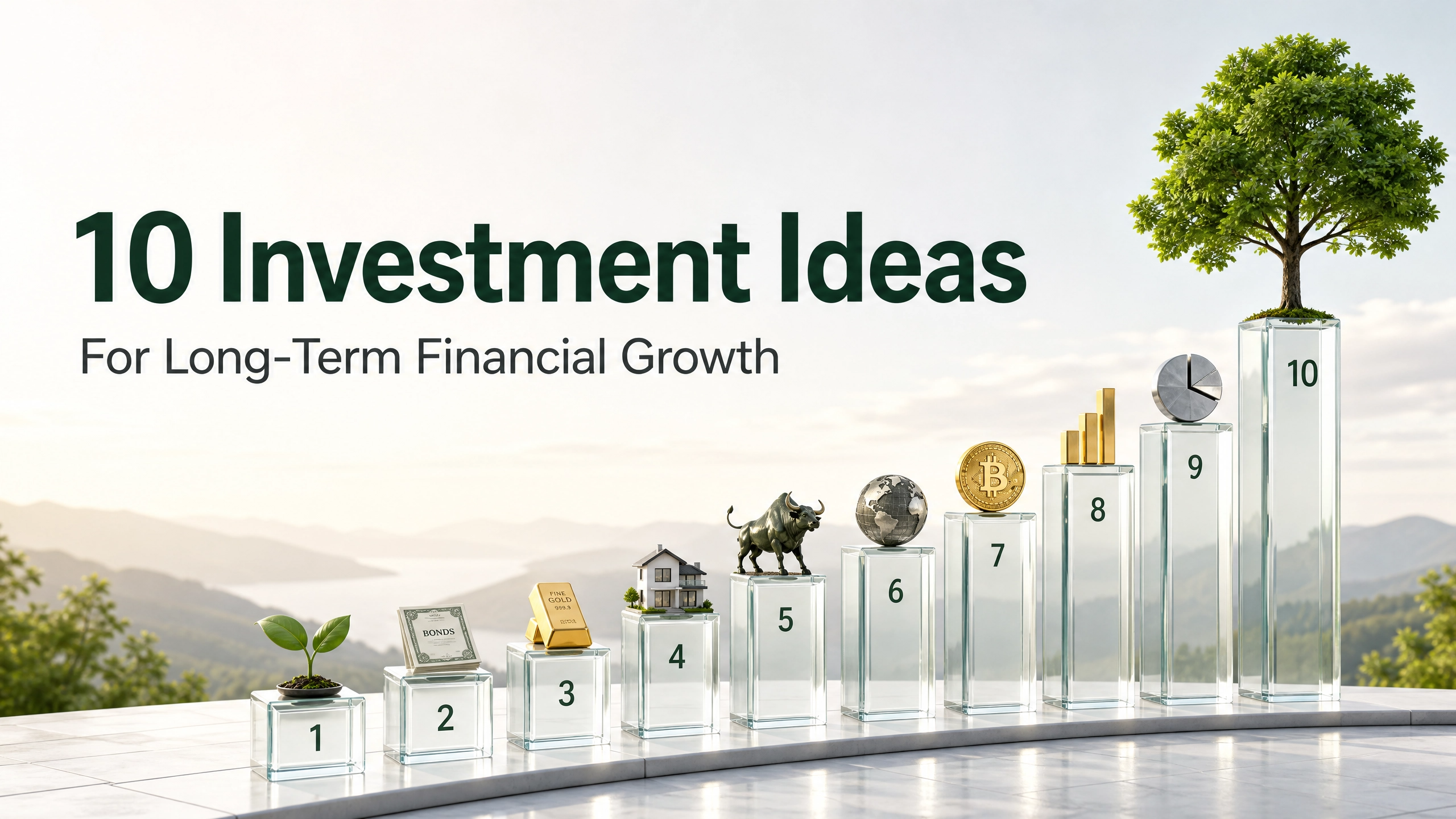

Building long-term wealth is not about chasing quick wins or risky trends. It is about making consistent, informed decisions that allow your money to grow steadily over time. Whether you are just starting your investment journey or looking to strengthen your portfolio, choosing the right long-term investment ideas is crucial.
In this guide, we’ll explore ten powerful investment options that can help you achieve sustainable financial growth. These strategies are designed to balance risk and reward while focusing on wealth creation over years or even decades.
1. Stock Market Investments
The stock market remains one of the most popular and effective ways to build long-term wealth.
When you buy stocks, you are purchasing partial ownership in a company. As the company grows, so does the value of your investment.
Why stocks are powerful for long-term growth:
- Historically high returns over decades
- Opportunity for dividend income
- Easy access through online platforms
- Compounding growth potential
Best approach:
Instead of trying to pick individual winners, many long-term investors choose diversified index funds or blue-chip stocks that have a proven track record of stability and growth.
Patience is key—stocks perform best when held for many years.
2. Index Funds and ETFs
Index funds and exchange-traded funds (ETFs) are among the safest and smartest investment options for beginners and experienced investors alike.
They allow you to invest in a basket of stocks instead of relying on a single company.
Benefits:
- Instant diversification
- Lower risk compared to individual stocks
- Low management fees
- Consistent long-term returns
For example, an S&P 500 index fund gives exposure to 500 of the largest companies in the U.S. economy.
This makes ETFs a foundation for any long-term portfolio.
3. Real Estate Investments
Real estate has long been considered a cornerstone of wealth building.
It provides both appreciation (increase in property value) and income through rent.
Types of real estate investments:
- Residential properties
- Commercial real estate
- Rental properties
- Real Estate Investment Trusts (REITs)
Advantages:
- Tangible asset
- Passive income through rent
- Hedge against inflation
- Long-term appreciation
Even if you don’t buy property directly, REITs allow you to invest in real estate with lower capital.
4. Dividend-Paying Stocks
Dividend stocks are companies that regularly share a portion of their profits with shareholders.
These investments are ideal for long-term income and compounding growth.
Benefits:
- Regular passive income
- Lower volatility than growth stocks
- Reinvestment opportunities
- Stable companies with strong financials
Over time, reinvesting dividends can significantly increase total returns due to compounding.
Popular sectors include utilities, consumer goods, and healthcare.
5. Retirement Accounts (401(k), IRA, etc.)
Retirement accounts are one of the most effective long-term investment tools due to tax advantages.
Depending on your country, accounts like 401(k)s or IRAs (in the U.S.) offer:
- Tax-deferred growth
- Employer matching contributions (in some cases)
- Long-term compounding benefits
Why they matter:
Even small contributions made consistently over decades can grow into substantial wealth thanks to compounding and tax benefits.
If your employer offers a match, it’s essentially free money—never leave it unused.
6. Bonds and Fixed-Income Investments
Bonds are lower-risk investments that provide steady income through interest payments.
They are ideal for balancing risk in a portfolio.
Types:
- Government bonds
- Corporate bonds
- Municipal bonds
Advantages:
- Predictable returns
- Lower volatility
- Portfolio stability during market downturns
While returns are generally lower than stocks, bonds play a crucial role in risk management.
7. Mutual Funds
Mutual funds pool money from many investors to invest in diversified assets.
They are actively or passively managed depending on the fund type.
Benefits:
- Professional management
- Diversification
- Easy access for beginners
- Long-term growth potential
Mutual funds are a good option for investors who prefer a hands-off approach but still want exposure to markets.
8. Commodities (Gold, Silver, Oil)
Commodities like gold and silver are often used as a hedge against inflation and economic uncertainty.
Why investors choose commodities:
- Store of value during inflation
- Portfolio diversification
- Safe-haven asset during market volatility
Gold, in particular, has historically maintained value over long periods and is widely used in investment portfolios.
However, commodities should only represent a small portion of a diversified portfolio.
9. Peer-to-Peer Lending
Peer-to-peer (P2P) lending allows investors to lend money directly to individuals or businesses in exchange for interest payments.
Advantages:
- Higher returns compared to traditional savings
- Passive income stream
- Diversification option
Risks:
- Borrower default risk
- Platform reliability concerns
To reduce risk, investors typically spread investments across many borrowers rather than funding a single loan.
10. Business Investments and Side Ventures
Investing in businesses—either your own or others—can lead to significant long-term financial growth.
Options include:
- Starting a small business
- Investing in startups
- Buying shares in private companies
- Franchise ownership
Why it works:
Businesses have unlimited growth potential compared to traditional investments. However, they also carry higher risk.
Successful business investments often require research, patience, and active involvement.
Building a Long-Term Investment Strategy
Having investment options is not enough—you need a strategy that combines them effectively.
A balanced long-term portfolio may include:
- 40–60% stocks or index funds
- 10–20% bonds
- 10–20% real estate or REITs
- 5–10% commodities
- Small allocation to alternative investments
This structure helps balance risk while maximizing growth potential.
Key Principles for Long-Term Financial Growth
Regardless of which investments you choose, success depends on a few timeless principles:
1. Start Early
The earlier you invest, the more time compounding has to work.
2. Stay Consistent
Regular investing beats timing the market.
3. Diversify Wisely
Never rely on a single investment type.
4. Reinvest Earnings
Dividends and returns should be reinvested for maximum growth.
5. Think Long-Term
Avoid reacting to short-term market fluctuations.
Common Mistakes to Avoid
Even good investment ideas can fail if handled poorly.
Avoid:
- Emotional trading
- Over-concentration in one asset
- Chasing hype or trends
- Ignoring risk management
- Withdrawing investments too early
Long-term wealth is built through discipline, not speculation.
Also Read: Smart Investing Strategies: How to Grow Your Wealth in 2026
Final Thoughts
The top 10 investment ideas for long-term financial growth all share one thing in common: they reward patience and consistency.
Whether you choose stocks, real estate, ETFs, or business investments, the key is to start early and stay committed.
Wealth building is not about timing the market perfectly—it’s about time in the market, smart diversification, and disciplined execution.
By applying these strategies, you can build a strong financial foundation and move steadily toward long-term financial freedom.