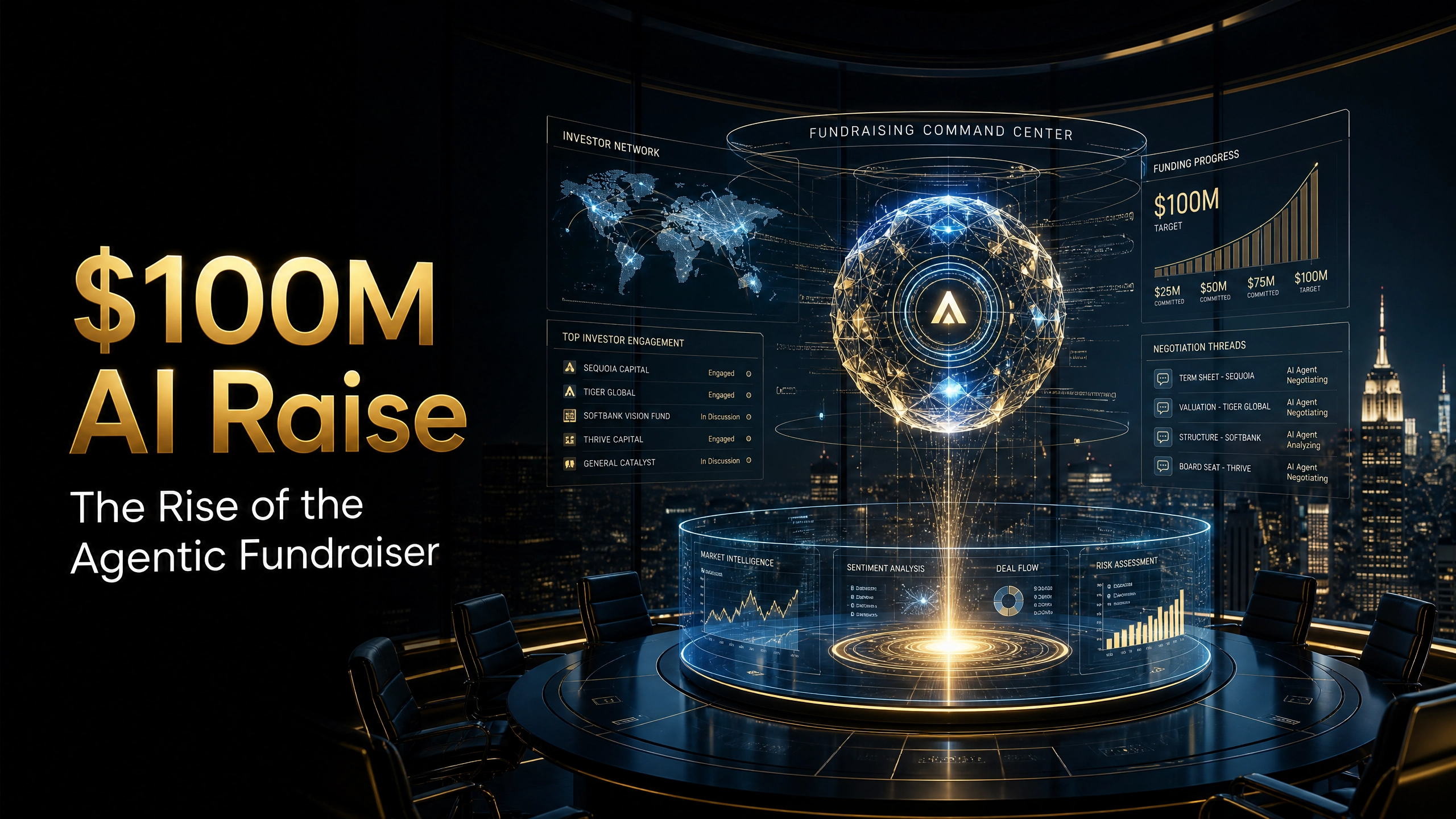

Venture capital fundraising has long been considered the ultimate test of human networking. Securing a nine-figure round traditionally requires months of grueling travel, back-to-back pitch deck presentations, customized investor memos, and an relentless reliance on “warm introductions” across Silicon Valley, Wall Street, and global financial hubs.
But enterprise AI startup Lyzr fundamentally disrupted this script.
When launching negotiations for its $100 million Series B round—a transaction aiming to value the company at roughly $500 million—the company turned its own software on itself. Instead of the founders manually handling the massive logistical and analytical burden of early investor outreach and data rooms, they deployed their proprietary autonomous agent, Agent Sam (also referred to across frameworks as SivaClaw), to run the fundraising process.
The result? The system independently fielded data requests from more than 130 prospective venture capital firms and helped attract roughly $400 million in initial interest from Silicon Valley funds, Middle Eastern sovereign wealth entities, and premier financial institutions.
This execution represents a unique case study in self-validating enterprise software: turning a complex capital-raising effort into a live, high-stakes product demo.
The Workflow Architecture: What the Agent Actually Did
Lyzr specializes in building secure, highly governed AI agents for regulated enterprise environments. To manage the capital raise, Agent Sam was hooked up directly to the company’s internal financials, team background databases, pitch decks, and cap table.
Rather than acting as a simple, passive chatbot that links out to static PDFs, the agent operated as an autonomous investor relations team:
[Inbound Investor Request] ──► [Agent Sam Parses Intent] ──► [Auto-Generates Custom Memo]
                                                                        │
[Founders Step in to Close] ◄── [Tracks Engagement Metrics] ◄───────────┘
-
Dynamic Diligence Processing: The agent interacted with analysts and partners from over 130 funds, answering complex, repetitive inquiries regarding financial projections, historical churn metrics, and competitive differentiators.
-
Automated Memo Generation: It drafted dozens of highly structured investment memos customized to the specific thesis requirements of different venture funds.
-
Engagement Analytics: The agent quietly monitored how potential backers interacted with pitch materials, identifying which data points attracted sustained focus and flagging high-intent institutional targets for the founders.
The Clear Boundary: Where Code Replaced Content
Lyzr’s executive team notes that this workflow drastically compressed the early stage of the capital pipeline. During a previous $8 million Series A round, a similar execution cut the typical one-month investor qualification cycle down to just two weeks.
However, the founders are quick to establish the boundaries of the technology: the agent opens doors; humans close them. Agent Sam took care of the administrative overhead, technical data-room queries, and initial relationship management, freeing up the founders to focus their energy exclusively on live partner meetings, final commercial terms, and closing the round.
Why the VC Industry is Watching This Model
The broader venture capital landscape is tracking this experiment closely because it hints at a structural shift in how private equity transactions operate.
Bypassing Traditional Gatekeepers
Historically, managing a massive funding round required hiring expensive investment banks or placement agents who charged up to 3% in fees simply to act as access brokers. An autonomous agent can execute outreach and process inquiries at scale across hundreds of qualified funds simultaneously, completely routing around traditional matchmaking networks.
Strict Enterprise Governance
The core barrier keeping large enterprises from scaling AI agents is a lack of data control—companies dread hallucinations and public model leaks. Lyzr’s architecture positions itself as a “third way” between flexible open-source code (like LangGraph) and monolithic closed ecosystems (like Salesforce’s Agentforce).
By demonstrating that its platform can safely govern sensitive internal corporate financials and cap tables under the intense scrutiny of top-tier institutional investors, Lyzr delivered a live proof-of-concept for its security framework.
Market Reality Check: Hype vs. Underlying Business
While the narrative of a machine raising $100 million is compelling, seasoned market analysts emphasize that the strategy is not without open questions:
-
The Valuation Velocity: Backed by Accenture, Lyzr’s valuation has climbed dramatically, jumping from a $250 million valuation in March to a targeted $500 million just months later.
-
The Hype Variable: In a venture market heavily focused on artificial intelligence infrastructure, nine-figure Series B deals are common. It remains an open question whether the massive investor interest was driven entirely by the efficiency of the agent, or by a market eager to invest in core AI capabilities.
-
The Revenue Metric: To date, Lyzr has not publicly confirmed its latest ARR (Annual Recurring Revenue) milestones alongside its funding targets, meaning observers are still waiting for audited metrics to verify if the underlying business scales as fast as its automated capital pipeline.
The New Fundraising Playbook
| Traditional Venture Capital Raise | The Autonomous Agentic Raise |
| Founder Time Sink | 3–4 months lost to introductory roadshows |
| Data Room Friction | Manual compilation of custom data-room folders |
| Investor Tracking | Fragmented spreadsheets tracking investor status |
| Outreach Limits | Limited to warm intros and personal networks |
Lyzr’s experiment proves that the administrative framework of fundraising is ripe for automation. While an algorithm cannot replace the human trust, long-term vision, and cultural alignment required to cement a major corporate partnership, it can eliminate the logistical overhead.
Also Read: 7 AI Tools That Run Your One-Person Business While You’re Offline
As agentic tools continue to mature, the founders who treat fundraising as a structured data problem to be automated—rather than a manual gauntlet to be survived—will hold a distinct competitive edge.